Sunday, April 22, 2012

VISUAL LITERACY

Visual literacy is the ability to interpret, negotiate, and make meaning from information presented in the form of an image. Visual literacy is based on the idea that pictures can be “read” and that meaning can be communicated through a process of reading. - Wikipedia

Visual literacy is increasingly important in the digital age. Cable news channels rely heavily on multiple layers of graphics to convey several different pieces of information at once. A Web site can feature any combination of visual media on a potentially endless scrolling canvas. YouTube, having grown beyond a simple repository for streaming videos, has become a distribution system for user-generated content. The age places new demands upon the user as not only a consumer of information, but as a producer of it. Simply put, the average person today is living in a far more mediated culture than ever before. The ability to make sense of the endless onslaught of visual media is essential.

Visual literacy can be used in many ways in the elementary classroom. One activity I saw in a video that was very effective was young students creating a map of their neighborhood using signs and chairs. This taught them simple directions and how to navigate around an area by using maps. Students learned how to associate signs and symbols with real-world directions and places. Another way visual literacy can be used in the classroom is by creating concept maps. These are often done in science classes, as there are so many processes and systems that can be represented with images, such as the water cycle and layers of soil. Concept maps can also be used in literary subjects, such as creating venn diagrams to compare characters in a story or creating a story web to organize events. These are all ways in which visual media can be used to encapsulate ideas and information. -----

 For this project, I have decided to use a comic strip as an example. It is called "Worm's Eye View", and it comes from the book The Big City, by Will Eisner. I have been surrounded by comics my whole life, so I thought this would be an interesting choice. This particular comic uses no words and shows only a limited view of the action. It is very open to analysis and interpretation.


 Here are my thoughts and breakdown of this comic, beginning with general ideas and moving to specific ideas for each panel:

GENERAL NOTES

 * It's black and white.
 * There are two people: a man and a woman.
 * No faces, no words.
 * Same setting/angle in each panel.
 * Open for interpretation.
 * The characters don't move very much.
 * It looks like we are looking at them from someone's perspective.
 * They are well-dressed.
 * They're meeting up on the sidewalk in public.
 * The clothing of each person suggests their respective genders.
 * The direction they're facing (toward each other, away from each other) suggests their comfort level.
 * The foot movement suggests what they're doing and how they're feeling. For example, their closeness and the raised foot in the  last panel indicates an intimate moment. The body language in general is conveyed through the feet.


PANEL 1: They're walking toward each other.
 - They seem to know each other.

PANEL 3: She's tapping her foot/they're shuffling their feet.
 - They are briefly uncomfortable.

PANEL 5: He's hugging her from behind.
 - He attempts to comfort her.

PANEL 2: They stop to chat.
 - Maybe they're sneaking around.

PANEL 4: They're facing away from each other.
 - They are in deep thought. They seem uncomfortable about something.

PANEL 6: They face each other and kiss.
 - They have resolved the uncomfortable issue.

Tuesday, December 14, 2010

It pains me to admit this, but...

... I am extremely impressed by Apple.

They have done a great job of making their products accessible to people with disabilities. My sister is a die-hard mac-o-phile, and consistently puts down my PC and defends her Mac's honor to the grave. I remember near the beginning of the semester in CEP class, when Ira and Sara were showing us many of the useful accessibility features Firefox offers--for free. Ira mentioned that most of these features are capable on a Mac as well, but that separately they would cost several hundred dollars.


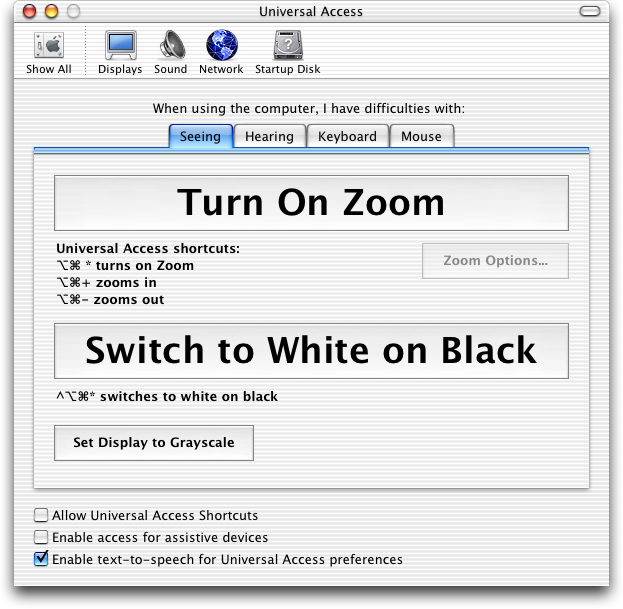
I mentioned to my sister that while her cool, awesome, totally righteous Macbook Air may fit her needs perfectly, there are many features and programs for differently-abled people that PCs offer for free. Ha! I thought I had her cornered! She started at me as if I were an alien. She immediately navigated me to the Universal Access panel, and looked very triumphant. I was honestly very impressed.

The options themselves were very simple to read and understand. They used very straight-forward language, directly asking the user what it would like assistance with. The number of general options, such as zoom, high contrast, text-to-speech, keyboard shortcuts, etc, were generous, but those were just the basics.

I'm starting to think I misheard or misunderstood Ira way back then.

The advanced programs included such awesome technology as Voiceover, a program designed for the visually impaired, which allows the user to swipe/flick their finger across the screen and hear what items they are rolling over. So, after many uses, the user starts to feel comfortable with distances and strength necessary to navigate to particular parts of whatever they're viewing on the screen. Very cool!

Equally cool is Inkwell, designed for those with trouble using the keyboard, which allows one to connect a tablet to their Mac and write directly on it. The written words are converted into text right there on the screen. Let me tell you, I destroyed my own laptop's keyboard with coffee, and using Windows' on-screen keyboard was torture. Their speech-to-text feature was also severely lacking. But inkwell is something I could definitely get used to!

So, I decided that my new fondness for Apple and genuine appreciation of their dedication to helping the differently-abled warranted a little more research and discussion. I scrapped my original final project idea in favor of one advertising the benefits of Mac for all students, specifically those with disabilities, and the teachers who teach them as well. Enjoy!

Monday, December 13, 2010

Rant # 590869 about the flawed educational system

I am in the midst of a dismal situation with the College of Education here at MSU. As part of our application, we have to complete an essay. No sweat for me; I'm a great writer and I could prattle on for days about my favorite subject: myself. Piece of cake, right?

WRONG~!

The essay needs to be taken in a computer lab on campus, with everyone else who registered to take it that day. We are only given one hour, ONE hour, to finish the entire thing. And of course we weren't given the actual topic in advance.

Once the time was started, I immediately was overwhelmed by the furious smashing of dozens of keys. It was so loud and discordant that I wasn't sure I'd be able to begin. But, I relaxed. It took me at least 10 minutes to actually begin typing words, and several more after that of deleting and cutting and re-typing until I finally hit my stride.

My stride, unfortunately, can be a bottomless pit. It took a long, long time for me to actually come to the point I was trying to make, which answered the initial question asked of me. Time was up before I could even form the sentence of my point. I asked for just a few minutes longer to finish, but was of course denied.

I visited the CoE in person to ask if I could be granted more time to finish the essay. I am registered with the RCPD, and had I been a more conscientious, steadfast student, I would've known that I could've had accomodations for my essay that would have easily allowed me to finish.

Of course, this was told to me: "It says it right here on the application."
"No shit!", I wanted to say. I'm very aware now that I could've had assistance. I've only been in the RCPD for a year, and I'm honestly not used to requesting accomodations yet. It doesn't occur to me very often. I wasn't claiming that I was ill-informed; I was simply asking for mercy.

After some stress and tear enducing time had passed, I was given the option of submitting a final paragraph to the coordinator, or re-writing the essay. I was denied the option to actually see my previously written essay so that I could work my new paragraph into it. That option was undesirable, and even more so was the option of re-writing the whole thing. I don't have the time and energy to devote to another heart-wrenching, soul-exposing extremely personal essay. Sorry!

So here I am, choosing the lesser of two evils: To complete the essay and e-mail it to someone. This proves difficult without knowing exactly where I left off, but I will take what I can get.

Now, to the point of THIS blog post. Why wasn't I allowed to see my essay? How would it affect the essays written by the other students? Who would I be hurting? Why am I unable to access my own words?! Arbitrary rules are the bane of the educational system. "Because we said so" seems to be the mantra for way too many educators and administrators. Try to present them with a rational argument and they get threatened, and cast you away as some bratty smart-mouthed kid.

Even in college. Even as grown adults, we are still treated like little children who are unable or afraid to question anything. When we do we get mundane, useless answers. Higher-ups are terrified of younger people standing up for themselves and defending their rights as, wait for it, individuals. Individuality is certainly one of the biggest threats to those who play strictly by the rules.

The fact that the essay had to be taken in a room filled with others, within an hour, and with no ability to save it or view it later, speaks for itself as a rescrictive and opressive policy. Quoting myself to the woman from whom I was begging for assistance, "Isn't this what teaching is all about? Recognizing and respecting differences?"

Apparently not. In one of the videos we watched earlier in the semester, we learned how public schools were originally modeled after factories. Far too often, I feel like not much has changed.

Monday, December 6, 2010

I just watched the "YouTube in Classrooms" video by Bill Genereux, and I must say it was highly disappointing. In his introduction, Bill appears leery of technology, commenting that technology often seemed overabundant. This was a strange lead-in, as I was of the impression this video was as progressive as others we've been seen in support of technology and social networking in schools.

It occurred to me that Bill was being sarcastic, or parodying the feelings of most public school educators, but honestly I'm still unsure of his intentions. The video begins by revealing how many students out of 11 in a random classroom (no grade level or subject is given) have some form of camera or video recorder on their person. All of them have at least one.

Bill shows clips of students blogging on YouTube, mostly complaining how bored they are of school, how much they hate it, what they'd rather be doing, etc. Surely this isn't the opinion of all students, and there are certainly more insightful student videos out there. He continues showing students recording their teachers during class, many openly defying them as classmates laugh. Teachers even look directly at the students' cameras and make little to no effort to confiscate them. I believe this is all done to show awareness of poor uses of YouTube in classrooms and why many teachers would not support said use. Candidly, I don't think this does more damage to Bill's cause than anything.

The video paints a very dismal portrait of American public school students until nearly the very end. After showing us clip after clip of disturbing student behavior, Bill does a 180 and attempts to show us the positive aspects of YouTube in classrooms, and I believe he falls very short. His own description of his video claims to show "an unprecedented look into the world's educational institutions." This is a far cry from what we are actually shown. Bill very briefly mentions the possibility for global communication via YouTube by showing us a few clips of supposed students from other countries. We are not told what countries these are, and the clips are not particularly useful. No communication across nations is actually shown; the videos are not in a context to which we as educators can relate.

Bill introduces us to a teacher named Jonathan Dale, who claims to video record his students as often as possible, giving very little insight or reasoning into his actions. Bill says he always "makes the students look good," and Mr. Dale says his classroom YouTube video uploads have led to an exchange of ideas among him and other teachers. I find this all highly disconcerting; a male 5th grade teacher claiming to keep a video camera in his pocket at all times just sounds creepy to me. I have a hard time believing that all the parents of his students have agreed to this practice and don't mind their children being so visible on the Internet. Once again, Mr. Dale never really gave us any rationale for his constant recordings, and neither does Bill.

I still don't understand what I was supposed to gain from it. Even the production quality was very low, and I dreaded watching it just from how poorly recorded it was. Bill and Mr. Dale may very well be "pioneers" and champions for technology in the classroom, but they come across as nothing of the sort in this video. I find both of them hard to understand, in the sense that I never really know their true opinions. I would not recommend that anyone watch this video, for any reason. It does very little to further the cause for YouTube and such technologies in the classroom; in fact I feel it does the exact opposite. I am left Googling for better videos to actually see the potential this video attempted to achieve. 

I came across this one, which was created by a 10th grade media arts teacher. She first gives a very detailed account of how she uses YouTube personally and shows many of its useful functions. She shows us examples of work her students have posted online for her to see, and even to edit to create a complete project. She assigns a video sequencing assignment which allows each student to edit a video clip of a specific situation, in this case a girl walking down a path, in a unique way. I actually think this assignment is pretty cool, and think it's a great way to gain a perspective on each individual student. It's very important to get a feel for students' personal views and forms of expression. Their creative capabilities are crucial to explore, and should be encouraged regularly. I think this teacher's assignment is an excellent way of utilizing all those concepts.

Friday, November 26, 2010

Collective Memory

I finally got around to checking out some of the links we were given to check out back in October. The post about Collective Memory was very interesting, though I didn't read the given Wikipedia article because it cited no references or sources. It's also important to note that the retelling of events from different perspectives can cloud one's original view of what happened and lead them to mix up their details with others'. I often find myself adding elements I've picked up online or from word of mouth into my own stories, and struggle to separate them from my own.

Also linked was the YouTube video The Machine is Us/Using Us, which I found fascinating. It actually triggered and refreshed some memories of my high school HTML authoring class and taught me a bit about RSS feeds.

I consider myself a mild computer geek; I've taken several computers apart and upgraded components myself. My insomnia leads me to stay up all night learning more and more about my computers each night, and my constant desire for the most modern technology leads me to research the newest processors, video cards, etc. However, I've never really been an Internet geek; I've had the odd blog here and there and have posted on forums, but I'm not at all savvy on the social networking front. I use Facebook constantly, but still cannot get the hang of Twitter. It seems to be such a useful tool, but I honestly just don't understand it. Myspace was given up years and years ago. I don't really read blogs unless they're assigned for this class, or linked to me from peers. I know that, as a future educator, knowing what's new and developing in the education world is crucial. It's been many years since I left high school, and I couldn't tell you what's changed at my previous schools since then.

It's practically the end of the semester, but I think the teachings of this class are finally starting to "click." I'm actually curious to read the status of federal funding, budget, and plans from the Obama administration for the current year. I've become a lot more political in the past year, and I definitely have a lot to catch up on.

Tuesday, November 16, 2010

IEPs

So, a week ago our lab class assignment was to draft an IEP for a hypothetical student based on a fictional excerpt. Professor Socol acquired a sample IEP for a "John Doe" from about.com, stating that it was absolutely terrible. However, I honestly thought it was okay on first glance. In fact, my group members and I ended up using some of the strategies outlined on it for our own IEP.

I especially liked these strategies: "Establish and use consistent classroom routine, prepare for transitions well in advance. Keep as predictable a schedule as possible.
Make use of computer technology where possible, and ensure John feels he is a valued member of the class. Always relate classroom activities to timetable and agenda."


These are very good strategies for those dealing with autism. Regularity and predictablility are key, as variations and the unexpected can be very difficult for he or sheto accept. Use of a computer is also a very good tool, as it is a silent, unchanging assistant upon which he or she can rely.

However, upon closer inspection, I did make the following observations:
  • The assistive technology section is severely lacking. John could definitely make due with some picture cards and schedules, possibly TTS software, VOCAs, etc. 
  •  The behavior expectations section was very ambiguous and seemed rather unachievable considering the small steps they were implementing. Specifically, "Develop skills to accept responsibility for self" and "Develop a positive self image" are great goals, but I don't believe they are reasonably achieveable over the course of a year. I would believe this would require extensive work with a behavioral psychologist, or at the very least, a school guidance counselor. There is no mention of either of those things in the IEP.
  • John is said to have been diagnosed with Multiple Exceptionalities’ which seems to me a very vague and nonstandard term. Googling it, it appears to mean one who is highly gifted while also having some sort of learning disability. I personally dislike the phrase and find it extremely confusing.
  • Onward, the IEP states that a "pediatric assessment" was done, determining John's autism diagnosis. This seems to be another vague term; it sounds to me as if "pediatric" should be replaced with "psychiatric." I'm unsure as to what a pediatric assessment actually consists of, and how it could be used as a diagnostic tool. 
  • Furthernore, the IEP does not state the degree to which his autism has progressed, so we know nothing of the severity of his condition. We are unaware of his capabilities and his struggles; we are not even sure why he needs special education assistance in the first place. Plenty of people who are high on the autism spectrum scale function perectly will in the general ed classroom with no assistance.

So, upon further examination and analysis, I do concur with Professor Socol that this IEP is indeed very poorly put together. It lacks insight, background information, a time frame, basic details, and specific, measurable goals. John Doe is not getting the proper assistance that he needs, and would benefit greatly from having a more experienced and compassionate advocate working on his behalf.

Monday, October 4, 2010

Text to speech programs

I have a very difficult time reading. I was always an avid reader as a child and teen, but somehow in the last four years my attention span has shrunk, my mind wanders like a nomad, and I can't force myself to just do it. In fact, just thinking about having to read something fills me with a sense of panic and anxiety.

I thought that text-to-speech (TTS) software would be a great learning device for me. I was very excited at the prospect, and when Ira revealed all the different programs and technologies available on Firefox alone, I felt very positive that this could change the way I read and receive information.

First, we tried the Vozme program in class, which converts a string of text into an audio mp3. I can think of numerous applications for this; my first idea was to create an MP3 of an assigned class reading, load it onto my iPod, and then listen to it in my car while driving. A student who has similar issues with reading could also use this technique. A CD player is an inexpensive substitute for an iPod.

The Vozme program produced a relatively smooth reading of the text. It was easy to follow, though annunciation was awkward in some spots. Overall, I could see myself making regular use of this program.

Other programs though, such as FoxVox and Text to Voice used voices that were too mechanical and very difficult to understand. FoxVox came equipped with a UK male voice, and the accent made the words almost incomprehensible. Though, I was sampling text from J.M. Barrie's Peter Pan (which I acquired through Project Gutenberg online), which is very dense and uses more archaic English. But even selecting just a simple sentence for the voice to read proved difficult to both my boyfriend and me. I had to research and spend a lot of time downloading and uploading a new, American English voice. I found that a female voice worked best for me, and that made the text much easier to decipher, but still too difficult for any serious use.

I also found out later that Vozme only can convert so much text. I'd have to create several MP3s for a few readings, which isn't difficult but can be time consuming, and frustrating figuring out when to cut off the text for the next recording. I did manage to fit 12.5 minutes of text from a reading assignment into a single MP3, which I did indeed transfer to my iPod and listen to on my drive back to Lansing from Detroit. I had to rewind the file to capture the exact words several times. I even let it repeat several times in a row after it finished to make sure I caught most of the text. Once again, Vozme was the clear winner of all the TTS technologies I tried. Though I only had time to convert some of the text, I absorbed that much very well!

All things considered, I found the TTS programs to be useful, but disappointing in many ways. I'm not sure what I was expecting... a miracle cure for my reading blues, I suppose. But I am extremely glad that these programs do exist, and I am positive that they will continue to improve with time. I will continue working with them to train my ears to decipher mechanical, robotic female voices with ease!